

Monocrop Madonna
From tradwife to food forest, rewilding the art of homemaking

Listen via audio
This essay was written to be heard. Press play and let it find you sipping morning tea, on your commute, or during a slow walk.
Have dinner ready. Plan ahead, even the night before. Prepare yourself. Be fresh-looking! Clear away the clutter. Minimize all noise. A good wife always knows her place.
I followed the instructions exactly. Red-lipped, I zipped myself into a polka dot and white-trimmed dress, protected by my grandmother’s hand-stitched apron. I fetched the newspaper, gathered the cleaning supplies, and baked a chicken with all of the fixings. Everything was set in its place. Sixteen years old, armed with a JVC camcorder and a whole lot of teen angst, I made a feminist critique of traditional gender roles with the 1950s housewife as my muse.
My map was "The Good Wife's Guide," an article attributed to the 1955 publication Housekeeping Monthly. The instructions have circulated for decades as homemaking scripture, a dogma for how women should act and what they should live for.

Feminism revolutionized the autonomy of womanhood. Bras went up in flames, bank accounts opened in her name, divorce became hers to file, and her body, finally, was recognized as her own. She could enter a workplace without harassment. She could follow ambition without apology. She could choose motherhood or refuse it. A woman could be many things now. A wife was only one of them.
And then, the guide rebranded.

Today, the housewife has a sourdough starter and a TikTok, a linen apron that costs two hundred dollars and 11 million followers watching her make cough drops from scratch. She is the tradwife: young, pretty, perfectly polished, soft-spoken, abundantly fertile. The aesthetic is white as a picket fence, cottagecore and crockpot, built on the conviction that a woman's highest purpose is to make life beautiful for a man. She is presented as a corrective to modern chaos, an antidote to feminism's supposed failures, proof that the old ways were the true ways. She is the reimagined Madonna.
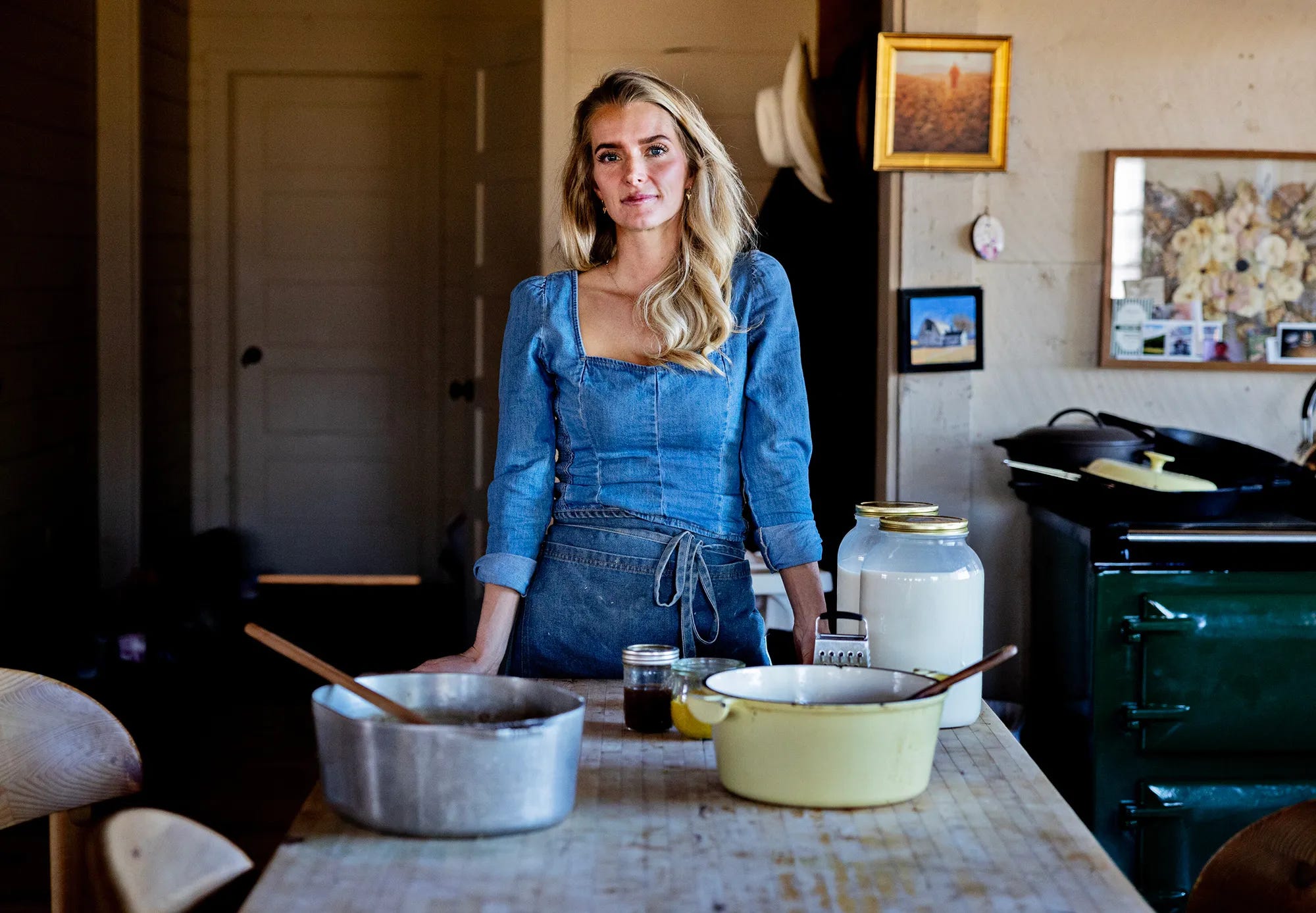
What the perfectly posed image does not show is her labor. The tradwife's domestic work, the cleaning, the childcare, the emotional tending of an entire household, is skilled and relentless, and it leaves no room for the messy, the frayed, the incomplete, the flawed. Exhaustion, grief, longing, and unmet expectations must all be edited out of frame before the camera turns on. What remains is the woman rendered as a still life: a composed and contained caricature of reality.
Across the spectrum of tradwife ideology, from the modestly dressed biblical wife whose submission is scripturally mandated, to the alluring influencer who speaks of traditional gender roles, the through line is the same: a woman's highest expression is obedience to a man, and that subservience is not chosen so much as cosmically ordained. Dominance and subservience are the natural order, the divine design, the way things were always meant to be. To question the hierarchy is to question God, or nature, or both. Therefore, a good woman must be a wife. And a good wife always knows her place.

The tradwife’s resurgent popularity rests partly on her aesthetic. Her rustic visual world is a palate cleanser to modernity’s slick digital screens, fast-paced burnout, and endless consumption, where we can purify our blue-light-strained eyes with the analog, the tangible, the slow and embodied. Our communities are fractured. Governments generally don’t care for or serve their people. Society in the United States is impoverished in the world of care, where labor rights erode, education is defunded, healthcare and housing slip out of financial reach, and the land is left to ecological collapse.
When larger systems are overwhelmed by ruin, we turn inward, toward the small radius we can control. We reach for stability. We long for home.
Homemaking is the ongoing creation of home through acts of love. It is embodied nourishment and care for life, love expressed through the physical reality of human needs being tenderly met. A wholesome meal. Freshly cut flowers. Crisp, laundered linens. Homemaking is tending to the living, giving form to love through caring for others.
Although homemaking is the answer to the tradwife’s deeper longing to nourish and be nourished, she is not afforded the opportunity to cultivate her domestic love with liberty. The fruits of her labor are harvested year after year without sufficient support, without mutual tending. Her life may look like abundance, but her roots are shallow, her nutrients depleted. And when the field turns barren, unable to produce any longer, it is framed as a personal failure rather than a structural one. The tradwife's shortcomings are due to her mental health problems—she's hysterical after all! She just needs medication, a new wellness routine, more faithful prayer, another baby.
The same ideology that cultivated her into a traditional wife domesticated the prairie into a monocrop. The soil is prepared. Root networks, microbes, the low green tangle of ground cover, cleared, pulled, and chemically dissolved the way her own complexity is tamed, silenced, and subdued. Diesel-powered steel blades tear through the earth in perfect parallel lines. Broken to receive petrochemical baptisms.
A thousand acres of repeating rows. Genetically identical monocrop monotony. A thousand influencers in hand-stitched aprons, identical in their soft-spoken yielding. Herbicides eradicate the strong ones who dare break the soil without permission. Her wildness is medicated, prayed over, hidden. Toxic shields of pesticides guard the vulnerable homogeneity. Botox protects her relevance. Water slips through the soil no longer held by entangled roots. More water. More dams. More children. More content. Drain the rivers for the thirsty fields. Take! Take until there’s nothing left.
Again, the cycle begins in depleted soil. More fertilizer. Stronger pesticides. More wellness routines. Stronger meds. The chemical runoff enters the watershed, seeping into breast milk, into the marrow of moles, into the sea. Her exhaustion leaks into her children, her marriage, into the women watching her on their phones. Hyphal fibers fray. Rhizomes rot. Worms wither. Pollinators perish. Her capacity for joy, for rage, for her own becoming, wilts. The soil, once prismatic in its diversity, ancient and self-correcting and alive, loses the capacity to feed itself.
We all starve on the acreage of industrial agriculture’s abundance. We all starve at the table of the tradwife’s performed plenty.
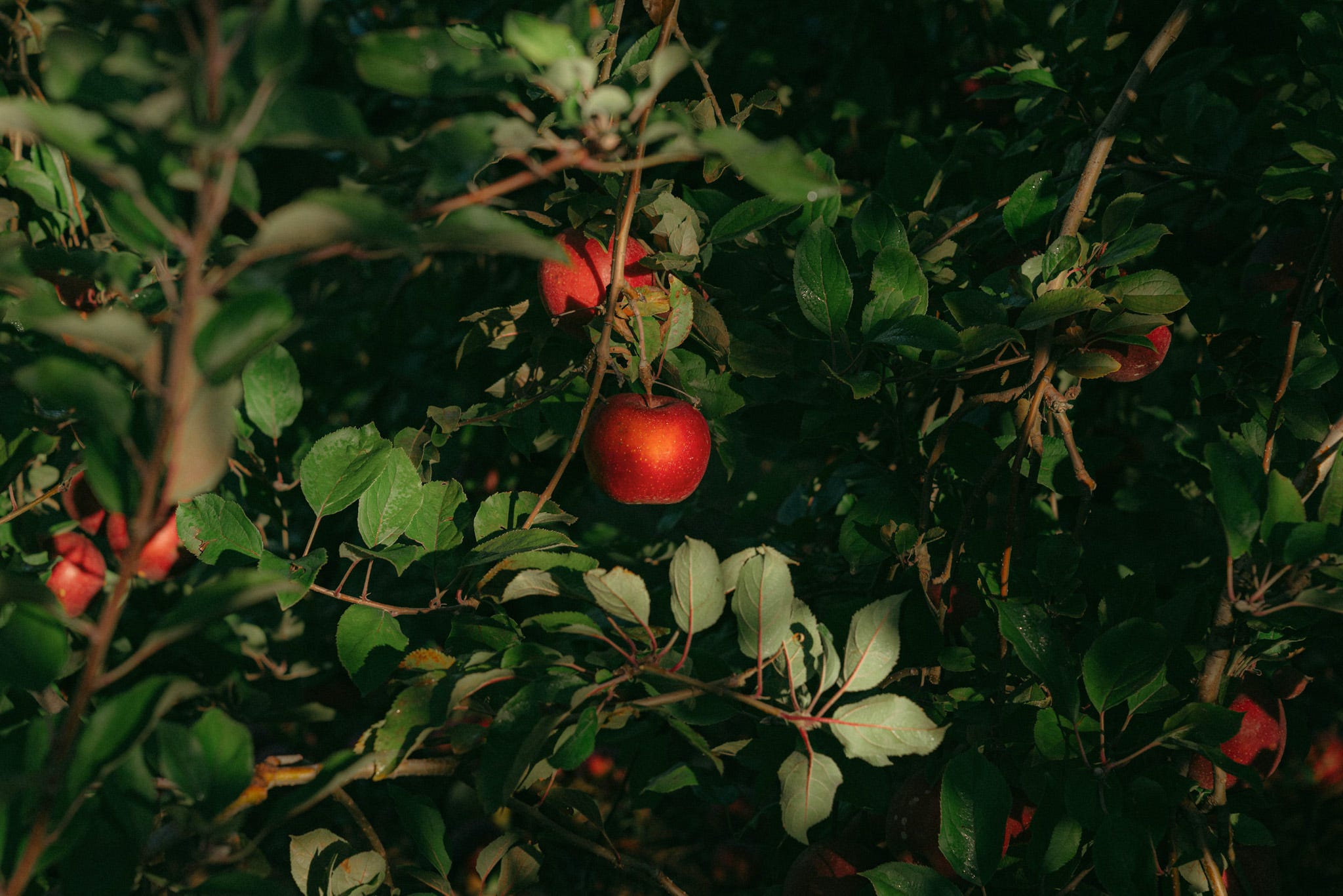
In early spring, before most pollinators have emerged, the apple blooms, and the orchard mason bee is already awake, nesting in hollow elderberry stems from last year’s growth. She caresses flower after flower with her pollen-dusted belly, moving between apple, serviceberry, blueberry, pear. Above, the chestnut holds the canopy, dropping protein-rich nuts for a hundred years without tilling. Cedar waxwings strip the elderberry beneath it, silken and masked, passing fruit beak to beak down the branch.
At the apple’s feet, comfrey sends its tap root six feet into the subsoil, drinking up potassium and calcium from depths beyond the apple’s reach. Cut three times a season and laid as mulch, comfrey releases those minerals directly into the apple’s awaiting feeder roots. Yarrow spreads its flat white umbels, landing pads for hoverflies whose larvae will devour hundreds of aphids before pupating. Creeping clover carpets the ground, hosting bacteria that breathe nitrogen from the air and bury it into the soil. The apple is fed by the trinity; so above, sideways, and from below.
Steel pruners meet wood. A clean clipped sound. Snap! The branch falls. The tree will allow for more light now, more air, more space for the bees to work the blossoms when they open. Hands move to the raspberry canes, snipping the spent ones at the ground, leaving the new green shoots standing. A currant is tasted, a delightfully tart burst. Another. Only the ones that slip easily from the stem are taken; the rest left for the tanager. Stained hands. Wet knees. The basket fills.
The daikon comes out of the ground with both hands, a slow resistance and then release, the soil offering the white oblong tuber with only slight hesitation. Paper skins warm from the sun, shallow-nested garlic bulbs lift easily from the earth. Carrots come in clusters, their feathery tops collapsing under the tension of uprooting their orange bodies.
In the kitchen, the outer leaves of the cabbage peel back slowly, each one a cool, veined fan. The daikon is sliced into white translucent-edged rounds. Garlic, bruised under the flat of a knife, releases its pungency into the room on a sharp aromatic wave. Under the weight of hand and salt, the cellular walls of the cabbage give way, the brine rises, the leaves weeping their waters. The jar is packed tight: daikon, cabbage, carrot, garlic, pressed down in layers, weighted below the surface of their own liquid.
The transformation happens without you now. In the absence of light, in the warmth of a closed space, the lactobacillus bacteria waiting in the skin of the cabbage, in the flesh of the daikon, on the surface of every vegetable, begin their ancient work. You provide the conditions, brine, darkness, time, and the culture creates itself.
Several days later, you open the lid, and the smell opens with it, sour and ferrous and alive, the aroma of transformation. You taste it after five days, after ten, learning the rhythm of it the way you learn the rhythm of anything alive, through attention and patience and the willingness to let it be.
Fermentation pulses with the same reciprocal intelligence as the food forest. The community of organisms inside the jar and upon the land are in conversation, metamorphosis moving through every participant simultaneously, decay and creation interwoven as one. Both ask the same commitment of the human hand: trust the intelligence inherent within the process of becoming.
Domestic life does not have to be domesticated. Sovereign seeds spontaneously sprout, the mason bee caresses the apple, the apple feeds the child, the child feeds the song that fills a kitchen where many hands are working; the grandmother who stitched the apron is teaching the hands that prune the branch, that read the bark, that taste the currant and leave the rest for the tanager, scarlet in the green, who scatters seed across the hillside where the opossum has already passed, depositing persimmon in her scat, fertility trailing behind her like a gift she will never know she gave, while the worm turns the offering into soil and the soil feeds the root and the root feeds the fruit, and somewhere a jar of brine is quietly becoming alive in the dark, and somewhere a body is lying in the grass doing absolutely nothing, and this too is the tending, this too is love, this is the multispecies ballet in which gender dissolves into what each organism offers according to its own nature. Abundant in its diversity, creative in its wildness, mutually beneficial all the way down and all the way up, sideways and forward in time, homemaking is the creation of conditions in which life can flourish.
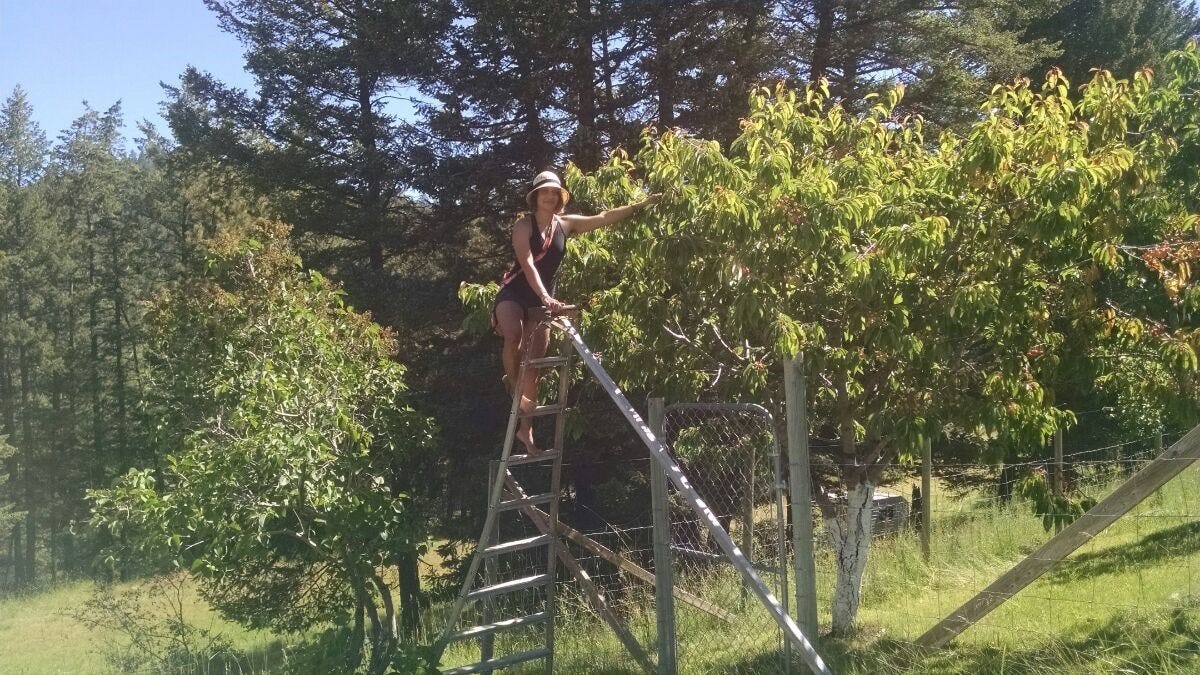
May this delicious vision help seed what homemaking (ecopoiesis) is becoming. 🙏🏼
Poetic. Articulate. Compelling. I loved listening to this Corina 🧡 This is true art needed for our times, art that makes the political personal again. Elegantly crafted and beautifully delivered. I hear your message and I am with you.